Wednesday, October 19, 2011

Haarlem - Grote Kerk, Dog Whippers, Ship Saws, and the Great Church of St. Bavo

St. Bavokerk
St. Bavo

Enter St. Bavokeri through the side Oude Groenmarkt, the old vegetable market, up at the altar area.  Churches are not just for the devout: churches are history.  Fine which churches are named for which saints, what did that saint do to deserve sainthood; and research for quirks in architecture found in those older church settings.

1.  Saint Bavo.  589-654 AD, Ghent, mostly, Belgium. 

Rubens painted him.  See http://www.flickr.com/photos/destinatio/373321887/  Bavo converted to Christianity and gave his goods to the poor.  Is that enough to be a saint? The criteria are surprisingly mild. This 6th-7th Centuries period is before the Roman Catholic branch severance from the Orthodox Christian branch, in about 1054 or so. Why is this St. Bavo in Haarlem.

There are references to St. Bavo, saving people from the "Kennemers." See http://www.haarlemshuffle.com/history/topic.php?id=8  The Kennemers were apparently a local tribe, but their appearance seems to come after St. Bavo.   The "Damiate" also refers to courage of Haarlem forebears, but so far we do not see Bavo. 

2.  Other cultural interest

In Haarlem's Great Church of Saint Bavo, there is a dog-whipper's chapel, behind an iron grill.  That chapel is for those who kept prayers safe by removing troublesome dogs from the church, thus saith the parish program at point VII.

There is the Brewers' Chapel, at point XiII. It belonged to the Brewers' Guild, fine, but its records on the walls there include two black marks.  These measure the height of the Giant Daniel Cajanus, whose height was 2.64 meters, or 8'8".  Daniel Cajanus lived 1703-1749 . He died in Haarlem 

Then it measures the Dwarf Simon Jane Paap at 84 cm, or 33".  He lived 1791-1829, and was buried in Zandvoort. 

So why is he here in Haarlem?

Of additional interest is the ships' models hanging from the rafters, opposite the Brewers' Chapel. There was once a mariners' altar there.
  • Three-master 12th Century frigate (what?)
  • Armed "pinace" also from the 12th Century (we have to go back!)
  • Shallow-draft armed yacht, 16th Century
History buffs:  As to the 12th Century ships, there apparently is a new weapon commemorated here, that we might have missed:

" *** an iron saw on the prow ... as written by John Evelyn in 1641: 'In memory of that invention of saws under their keeles with which they cutt the chayne before the Port of  Darniate', in order to conquer the city in 1219 under the lead of William I , earl of Holland. "

Haarlem.  Keep vetting.  Saint Bavo, why are you in Haarlem.  Bavo?  Bavo?  Are you there?  Why are you a saint,  Bavo?

Sunday, July 04, 2010

Zandvoort - Long flight - head for the beach

Zandvoort sounded like sand fort so we went.

Yes, it was.  We saw no fort but it is a beach area and a perfect first stop after long flight and getting the car. Take off the shoes, enjoy.

First things noticed on the way: don't bother spending money and time mowing along the roads if grass and flowers do not interfere with visibility. Yards, roadsides, natural and woolly. And raised pedestrian walkways, and peninsulas of trees and whatnot going right into the road so you have to creep, even one lane, through towns. Very smart. Just design the road so noone can go faster than you want them to. Compliance by design.


There is a nudist beach down the way, but we didn't know that at the time. The unseen nudist beach! Anyway, too early in the year, jackets weather, rain coming, say we, sour grapes ha. See ://www.naaktstrandje.nl/noordholland/Zandvoort/ZandvoortEngels.html/.  Go between pole 68 and pole 71, no dogs allowed, so we hear.

Go look up your own Images.

Tuesday, December 30, 2008

Keukenhof, Lisse. Tulips - Keukenhof Gardens


 Keukenhof:  Kitchen Gardens
Lisse

Tulips arrived in the Netherlands in the 1600's, courtesy of the Ottoman Empire. The flower had been wild, cultivated by the Turks as early as 1000 AD.  The name recalls the shape of a turban, see http://www.holland.nl/uk/holland/sights/tulips-history.html.

Update 2015:  a video on mechanized tulip bulb harvesting in The Netherlands, see http://www.youtube.com/embed/wZ5MAr7d-5Y?rel=0


If possible, time your visit to the Netherlands for tulip time, in May.  These fabulous and vast gardens close in July for maintenance and tidying up.  Most everything is tulips there, and tulips have a limited bloomsday.  See slide show at http://www.keukenhof.nl/. Keukenhof is a public garden -- there since 1949, and now nurtures some 6 million bulbs, says our guidebook. Another book says that some 7 million bulbs bloom each year. Area:  32 hectares.  What is that? A hectare is about 2.47 acres, see http://en.wikipedia.org/wiki/Hectare,  So:  somewhat less in area than 92 acres?

Keukenhof Gardens, tulips, Lisse, the Netherlands
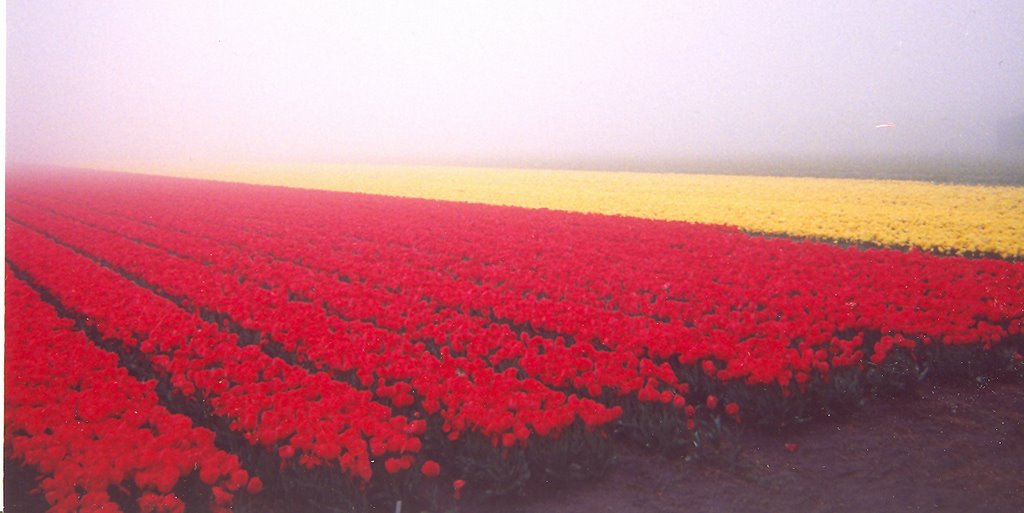
Even in the rain, the colors are spectacular. Winding, wide walkways, and varieties unimagined.


Arrival in the mist or light rain is fine.  A downfall of rain, however, would probably cause the petals to drop. We came almost directly from the airport, in case of heavier rains to come.


Keukenhof. Tulip fields, Lisse, the Netherlands


The choice is to head in another direction, and hope for better weather when you return.  Seize the day.

Some tulips are past knee-high, and even reach hip-height. Some were up to Dan's waist in some areas.  Long, long stems. See http://www/europeforvisitors.com/europe/articles/keukenhof_gardens.

There are well-spaced and spacious rest areas in the gardens, with food, facilities, but note where you came in. It is easy to get lost. This is a really big place.  It was once the hunting grounds of the Teylingen Estate, see 15th Century Countess Jacqueline of Wittelsbach at  http://www.keukenhof.nl/images/fck/File/KKH,%20sixty%20years%20as%20the%20paragon%20of%20beauty.pdf


Friday, December 26, 2008

Nijmegen - Operation Market Garden - Bridge; VE Day

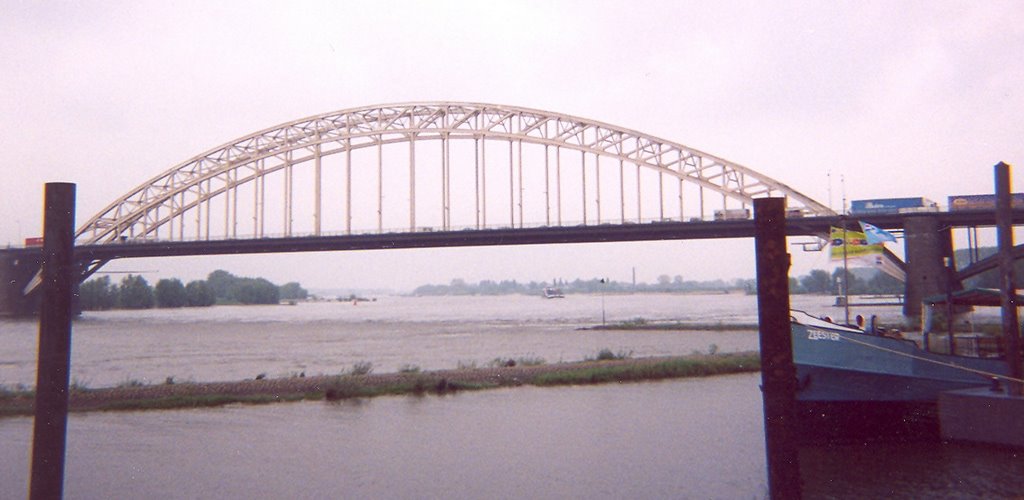
Nijmegen, Bridge, Operation Market Garden, the Netherlands

 WWII battle areas: Operation Market Garden, commemorated in the film story, "A Bridge Too Far" (that was the bridge at Arnhem, the focus of the British assault as part of the overall operation, to the north). Here is the bridge at Nijmegen, where the Americans fought.

The city is the oldest town in the Netherlands, see //english.nijmegen.nl/historical, dating from Roman times, and Charlemagne.

Operation Market Garden had tragic results, see www.thehistorychannel.co.za/site/features/operation_market_garden.php, but much heroism.

Hotel:  Skip the Casino area, skip the big ones, go right to the bridge bulkhead and look around.  There, at the river Waal,  by the Bridge itself, is The Hotel Courage. Small, excellent location - and not far from the casino, if that is your interest. The hotel is the houselike building in the foreground below.


Bridge at Nijmegen, view with The Hotel Courage  right there


Find the chronology of the battle at www.wingsofliberation.nl/mg-chrono-uk. The Netherlands retains its gratitude for the effort, despite heavy civilian losses. This has become a lasting bond - maybe that does require an overall war cause that is agreed at the time as necessary. Enduring memorials for valor. If there were not an agreed cause, would that have lasted.

Active river traffic.

See the barge going under the bridge in the picture - many barges on the riverways are also the family's home, and the family car may well be at the prow or stern, for use when docked. There is a great deal of that on the Rhine, in Germany. Also the family dog is often visible. And the car on the prow.

Veterans, and those just remembering, or tribute -- so many there, even after all these years. Several men were camped out under the bridge - not homeless-looking - more like veterans. Some slept all night there. We could see from our hotel.


US Troops.  I believe it was the US 82nd Airborne that focused at Nijmegen at Market Garden. There are annual marches by veterans. See picture and account of Operation Market Garden at www.strikehold504th.com/holland.php.

Nijmegen is in Gelderland, central and west in the Netherlands. See a Nijmegen guide at www.nijmegen.nl/ontdeknijmegen/english/index.asp.

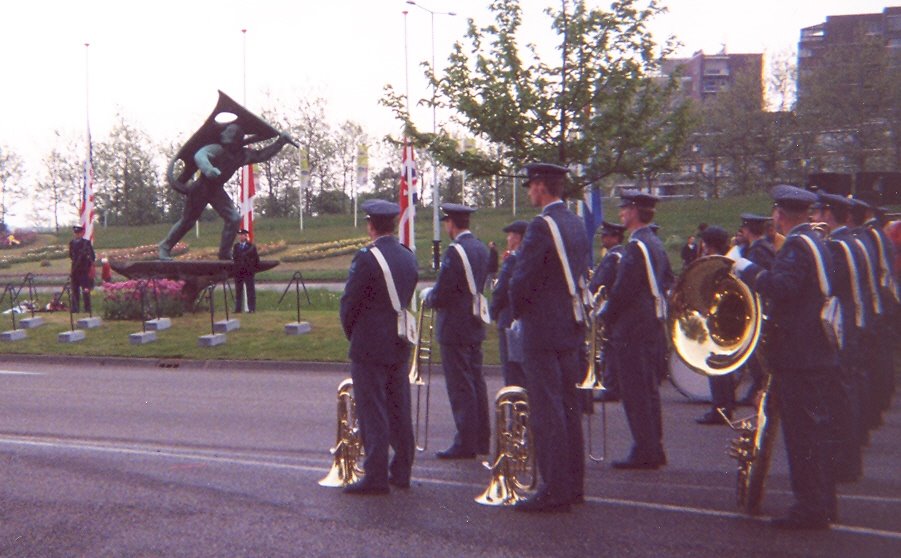
VE Day, 60th Anniversary Parade, Nijmegen, the Netherlands
For more complete website, see www.world66.com/europe/netherlands/nijmegen.

VE Day Commemoration.

This parade suddenly went by the window of little place where we were eating, at dusk.

The marchers were also in wheelchairs, and it looked like most of the town was participating. It looked like all surviving relatives were invited to join.

Nijmegen is also the site of an old Charlemagne castle ruin, see Charlemagne's biography and search for Nijmegen at www.chronique.com/Library/MedHistory/charlemagne. It is on the headland overlooking the river, part later rebuilt in 1030. The connections between places come as a surprise. The royal villa is referred to at www.heroicage.org/issues/6/forsman. This is in connection with Charlemagne and dispute resolutions. Romans also were here. See www.livius.org/no-nz/nijmegen/noviomagus-civil. There is a handy map there.

Thursday, December 25, 2008

Grosbeek, near Nijmegen. Canadian War Cemetery, VE Day

Canadians in the Netherlands. VE Day Commemoration at Grosbeek, near Nijmegen, 60th Anniversary.

There were large numbers of Canadian forces at Nijmegen, and the Netherlands still sends hundreds of bulbs to Ottawa. On VE Day, Canadian veterans and representatives are there for memorial services at nearby Grosbeek.
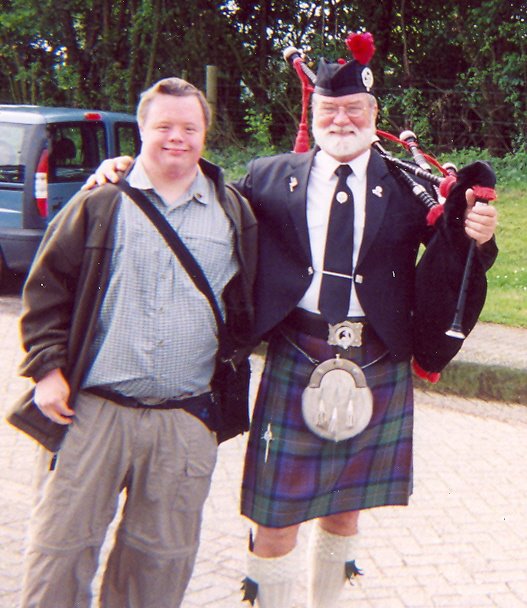
Canadian War Cemetery, Military Piper and Dan Widing, Grosbeek, the Netherlands
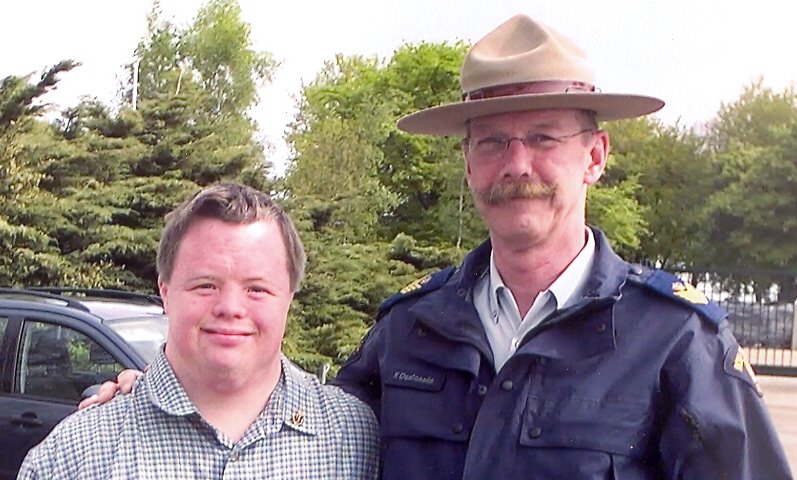
A national reputation is still honored. See the piper for the Canadian memorial service. That reminded us of another relative, a Royal Scots Fusilier, who died in WWI and is buried near Ypres, Belgium, at Arras, France.

Dan's grandfather was Canadian. We follow them.

The Canadians were doing the dirty work in the big dirty wars years before we, the Yanks, decided to get out of our isolationism and get our feet wet in the great moral issues. What's in it for us, we ask.  What can we do, asked the Canadians.  Is that so?  Prove us wrong.


Canadian Guardsman, Grosbeek Canadian Military Cemetery, NL

Friday, December 05, 2008

Kinderdijk - Windmills

Kinderdijk, windmill, the Netherlands

Windmills. Whoomp. Whoomp. Most seriously working windmills are the new tall skinny blingy kind that are white, look metallic, and three-armed and in great groups on windfarms.

But the old are still there, and many in use.  There are sails that attach to the arms to increase the whirl as needed; and a big log of a brake that jabs in to stop it and keep it stopped when that is needed.

These are huge. Whoomp. Watch your head.

Kinderdijk has a large set of windmills in one place.  In some, you can go right in, and climb all around and see where the family stayed and how they arranged their household and sleeping and living areas inside. Read about "Living In A Windmill" at www.kinderdijk.org/tour.


Watch the arms accelerate or slow when yanked on the anchor to stop it, and then adjust the canvas sails that are attached and rolled. More whoomp. Whoomp. Then see what it is doing for all that work:   there is a big screw that dips into the canal, and takes the water and pushes it up to the next level. You soon get used to the thumpiness. If you got careless and walked into one mid-whomp, there you go.

Windmill row, Kinderdijk, the Netherlands


Windmills are the workers that make the polders, the drained land now used for agriculture and settlements, even cities.  See how to drain farmland at www.nai.nl/polders/e/hoe_e.  From someone's bright idea, to a concept that supports the farmland that wasn't there before, that produces the food that feeds all the people. Go to that site for a film on how to reclaim underwater areas for farmland.

The windmills also powered mills.  You can see how it works, like water wheels making power. See ://www.kinderdijk.org/


Here is the farmland. The polder itself. Flat flat. Look closely, over our steering wheel for the masts moving along.  Looks like they are sailing right through the field.

Polder, or drained farm land. See mast of boat at eye level, canal across the field, near Kinderdijk NL
The canals network around at field level. If the draining failed, so goes the land.

Wednesday, December 03, 2008

The Hague - Madurodam Miniature Village, Scheveningen

We were interested in recreation and walking, so went first to Madurodam in the town of Scheveningen, that wonder-filled miniature Netherlands world that opened in 1952, a tiny Holland. Full photo tour here: www-pnp.physics.ox.ac.uk/~miyagawa/photo/travel/madurodam/

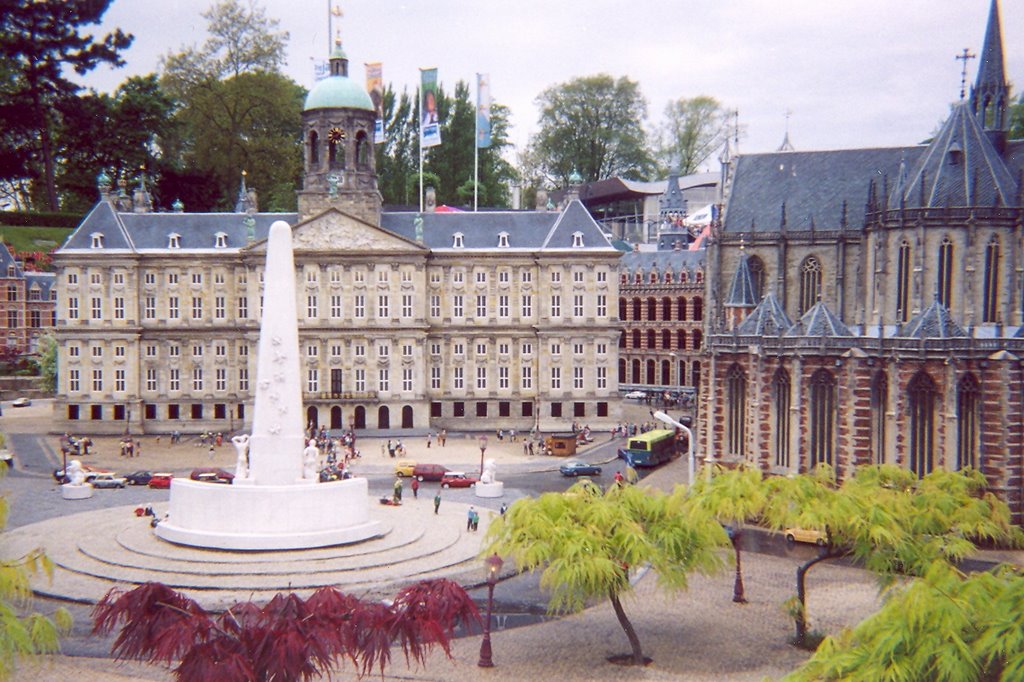
Madurodam Miniature Village, Scheveningen, near the Hague, NL
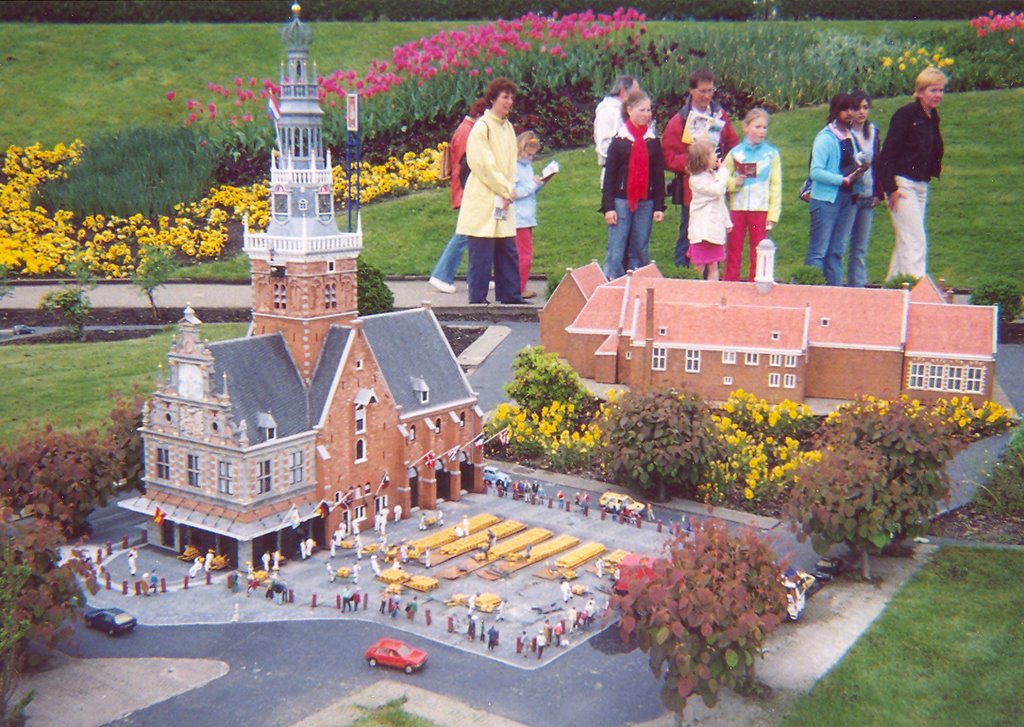

The village shows scenes from all over the Netherlands.


Scale of miniature village, Madurodam, NL

Then on to the Hague - arts, politics, courts, diplomacy. See www.denhaag.com/default.asp?id=DOORWAYNEWS-uk.

Our first picture - a sample scene that looks ordinary. Second picture - same town, but with giants.

Details:  Little boats glide around, trains and buses go, all of historically significant Holland (looks like) represented in some way here. It is outside The Hague. The towns are recognizable - Schiphol Airport, flat polder land reclaimed from the sea. All to scale.

History:  This site is a memorial.  JML Maduro built it in memory of his son who died in the concentration camp at Dachau in 1945. It is a large website, so look for The Hague and then Madurodam. See www.rozylowicz.com/retirement/holland2005/holland4. Profits to children's charities. Opened in 1952 by Queen Juliana.  For some cultural reference, see the 1920 passenger list of the T.S.S. Rotterdam to New York.  There are the Maduros.  See ://www.gjenvick.com/PassengerLists/Holland-AmericaLine/Westbound/1920-10-19-PassengerList-Rotterdam.html

Amazing humans. Out of Dachau, a dream at Madurodam.

Sunday, October 19, 2008

Middelburg's Bomb and Domburg's Commandos - WWII

Domburg, Allied Commando memorial, beach landing site, the Netherlands, WWII 
 
Domburg:  in the southwest Netherlands area known as Zeeland, a peninsula. It is a seaside resort, and here is someone's fine big beach house. Commandos landed here in secret, coming in on the waves.

Imagine the people inside sometime in 1945, probably suitably dressed for the evening dinner, with no idea that - just outside, at the beach, allied commandos are landing and creeping-dash-leaping from the shadows to some meeting place (blades in teeth?) and by now just outside the door. The memorial plaque says just that: allied commandos landed here.

A midget submarine, a WWII German Seehund, was found abandoned at Domburg. See www.one35th.com/seehund/sh_operation.

Trips and memory-triggers. For us, we think of the beaches at Highlands, New Jersey. The Twin Lights. Bay Head. In WWII, drunken soldiers coming up Portland Road, interrupting our hide-and-seek around the single street light, parents hustling us in until they passed, on their way to the Twin Lights and to the pillboxes and submarine spotting stations up further, way further if they could stagger that far, up the hill.  That area along the Shrewsbury River with the ocean beyond, used to be for bootleggers, and the docks with hidden ways. Then it was war.

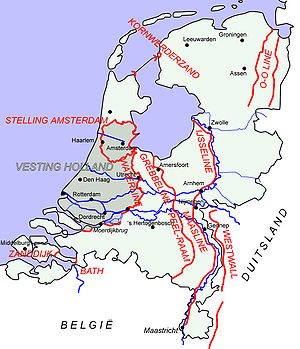
Middelburg-  Nearby is Middelburg, little city, big history. Quiet, traditional.  It dates from the 8th or 9th centuries, and had been a major port for the Dutch East India Company. The town is far off the regular routes.  We came to it just for the drive in remote sections, after all the urban, on our way back, after Belgium and Antwerp.  In 1940, the city was bombed by the Luftwaffe to force surrender of Dutch forces. The city is rebuilt, but archives were lost.

In the square is a model of a big bomb, on its end, as a reminder and memorial. This site shows "A Boy's Memories:"www.combinedops.com/Walcheren%20WW2_Memories.  Read about the Battle of the Netherlands and here is a fair use thumbnail of where Middelburg is, at ://image.absoluteastronomy.com/images/encyclopediaimages/d/du/dutch_defense_lines_-_ln-en.jpg

See
 full size image

Down there, 'way lower right, above the white of Belgium to the south.  Germany is at the other border, east. A lovely country ride. Bridges.
Etty Hillesum:  The young woman in her 20's who wrote a diary in Amsterdam during the War, and died in Auschwitz, was born in Middelburg. See the Virtual Museum at Middelburg at archimon.bravepages.com/zeeland/middelburg.

Saturday, October 18, 2008

Alkmaar - Cheese Market and Best Apartment

Alkmaar does a brisk cheese trade, but also caters to the tourists. Many photo ops.


Every Friday, as we recall. 

Alkmaar, cheese market, the Netherlands


Fridays are cheese market days - so we timed our visit to be in Alkmaar for it. The town is north of Haarlem, on the way to the big dyke, the Alfluitsdyk, across the North Sea, and do go that way. If no time, loop back to Amsterdam and Schiphol Airport.

Alkmaar's Cheese Market - see more at europeforvisitors.com/europe/articles/alkmaar_cheese_market.


Porters, Alkmaar cheese market, the Netherlands
Each of those big wheels of gouda, we were told by a porter, weighs about 13 kilograms, and at 2.2 pounds or so to a kilo, each wheel is about 30 pounds?


Color-coded cheese sleds, Alkmaar cheese market, NL


The porters are big. They have to be.  They carry the orders to the "public weigh house" on sleds, the colors matching the buyer. Here they are getting things ready, three empty sleds.


For a place to spend the night, we didn't want a regular hotel - all too far from the old town and its pedestrian mall - so went to the tourist bureau and found an address right in the old town. Most of the old town is walking only,so you have to park somewhere else and hoof. That's usual. And good for you, and why we pack so little.

World's best accommodation, Alkmaar, the Netherlands

Our spot at first look was discouraging - a large pub to one side where the overnight rental business was conducted, and since this is Holland, there is indeed overt overnight business being conducted all over.

There was an outside staircase to a second floor to rooms, and we just took it. Why not?

Indeed. It was there, and so were we.

Bonanza.

Inside was a full apartment, fresh and fine furnishings, all the comforts, and best of all, a huge jacuzzi and also a huge shower with a million heads jetting out absolutely all over. Loved it. Best apartment.

Dan's buddy the Porter.The next morning, one of the porters came in for coffee while we were at the pub next door for our breakfast, and told us all about what was to happen at the market. The lady in the picture above did a splendid breakfast and we think Alkmaar is terrific. We have no bathrooms like that here at our house. Must go back. Remember the number up by the door there and go. See what you can do when you are not on a bus?  Porters and sleds for cheeses.  Great fun for a tourist. And the town is lovely.

The city dates from the 10th century. See the history of Alkmaar at www.alkmaar.nl/portal2/pages/english/history.

Thursday, October 16, 2008

The Afsluitdijk across the sea; and Urk - Island fishing village, now on reclaimed mainland

Afluitsdijk, Commemorative sculpture to 1930's construction, causeway separating Zuiderzee from Ijsselmeer

AFLUITSDIJK

Dykes are everywhere; the largest is the Afsluitdijk in the northern area, finished in the 1930's. It is a 20-mile causeway to Friesland province. It holds back the North Sea (Zuiderzee inlet) from the fresh water lake, Ijsselmeer. Not clear what was saline or not before the dyke, but it appears that it was also saline but not sea-water strength. See the size of it in Afluitsdyk photos at outdoors.webshots.com/album/552587230IKkFdP. The major highway across the dyke is close to sea level - 7-9 meters.

It has sluices that flush in and out to maintain the salt that is in the Ijsselmeer, for ecological reasons; and to adjust for storms. Would Mississippi benefit from the technology? It is a matter of will, not way.

URK- The Island that is now a peninsula

The effect of the dykes, especially the Afluitsdyke and overall reclamation, has been to turn islands into towns on the mainland.

Urk Island Lighthouse, now inland (land reclamation), the Netherlands

Urk had been a remote fishing village, isolated on its own island, in the Ijsselmeer, east coastal area. With the large Afsluitdijk, the causeway across the northern Netherlands, now across from North Holland to Friesland, land is being reclaimed.  Urk, that once was an island with its lighthouse, is now mainland. The lighthouse at Urk is listed at www.lighthousedepot.com/database/uniquelighthouse.cfm?value=2140.

Urk dates from the 900's. See the history of Urk at www.answers.com/topic/urk. One of the oldest Dutch dialects is spoken there. See Urk overview at experts.about.com/e/u/ur/Urk.

Much of the land that had been underwater is now agricultural land. Wikipedia has a comprehensible writeup on these polders at en.wikipedia.org/wiki/Polder.